
What to Expect When You Return to Natural Hair Color
Barbara Davis
4/12/2026
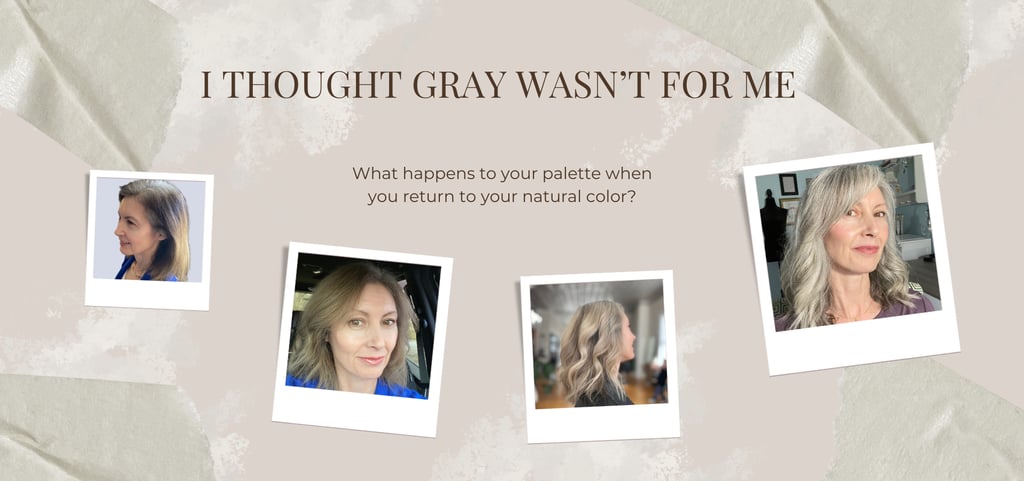
What to Expect When You Return to Your Natural Hair Color
If you’ve been thinking about growing in your natural hair color, you already know this is not a small decision. I put it off for years. As a Warm Autumn, I was convinced the coolness of my natural color would wash me out. In my mind, gray simply wasn’t my color.
But like some of my clients, I reached a point where I was tired of dyeing my roots every few weeks and was ready for a change.
The Real Impact
This can be subtle for some or quite dramatic for others. In my case, the shift was significant. My previous look was built around deeper, warmer tones, and the introduction of a cooler, lighter hair color changed the overall balance of my features.
This level of change depends on your original hair depth and how much pigment has softened over time. Often, adjustments are needed, even if they’re subtle.
Why Your Wardrobe May Suddenly Feel “Off”
Moving toward your natural color doesn’t automatically change your color season, but it does change how your colors look on you. Your hair frames your face, and when that pigment softens or shifts, a few important things can change: your overall contrast level, how defined your features appear, and how much color you need near your face.
Do You Need a New Color Season?
This is where there’s often some confusion. Some systems say your season never changes, while others allow for small adjustments over time.
Here’s the practical way to look at it, if the colors you used to wear no longer feel right, something needs to shift. That doesn’t always mean a different season, but it can mean lightening your palette, softening contrast, or adjusting how you wear your colors. The goal isn’t to stay loyal to a season, it’s to feel balanced and confident in your current stage of life. Personally, the Soft Autumn palette aligns closer to my natural coloring now.
Restoring Balance
I found that adding color near my face made an immediate difference in how bright my features looked. If I wore a light neutral top, a touch of color on my cheeks or lips helped restore that balance.
How to Approach This
If you’re considering this change, there are a couple of ways to get there. You can do this naturally and allow your new color to grow in, or you can work with an experienced stylist who can soften the hair contrast and make the process feel more seamless. I worked with Maci Lock, who helped guide my transition and create a more natural blend as my color grew in.
The Grow-Out Phase (What to Expect)
The early stages can be challenging. In the first few months, I wore a lot of hats to cover the regrowth. For occasions where I didn’t want my roots showing, I used hair mascara or color powder. Both worked well for quick, temporary coverage. I also tried a spray-on product, but had a negative reaction, so if you are sensitive to chemicals, be cautious with those.
Around the 4 to 5 month mark can be a good time to work with a stylist to introduce some blending if you don’t want to continue with a full natural grow-out.
A Shift in Perspective
When I first started in this field, I didn’t have much experience working with natural hair changes, as it was less common for women to move away from coloring their gray roots. That’s changed significantly in the last several years.
More women are choosing to embrace their natural color, and discovering how beautiful it is. With that comes a need to understand how it affects not just your hair, but your wardrobe, your makeup, and your overall look.
Need help navigating your color palette or wardrobe? You can explore my services at ForYourImage.com, or reach out directly to schedule your personal consultation.
Sign up for monthly inspiration
barb@foryourimage.com
Tel: (815) 450-3535
© 2025. All rights reserved.